
 Publish date: 26 January, 2026
Danish biotech and AI-for-energy rounds signal where hiring demand is heading
The clearest indicator of future hiring demand is rarely found in trend reports. It is found in term sheets.
In Denmark, two recent deeptech funding rounds offer a useful signal for workforce planning in 2026 – not because they herald a boom, but because they reveal what investors remain willing to back in selective markets: evidence-led execution in the physical world.
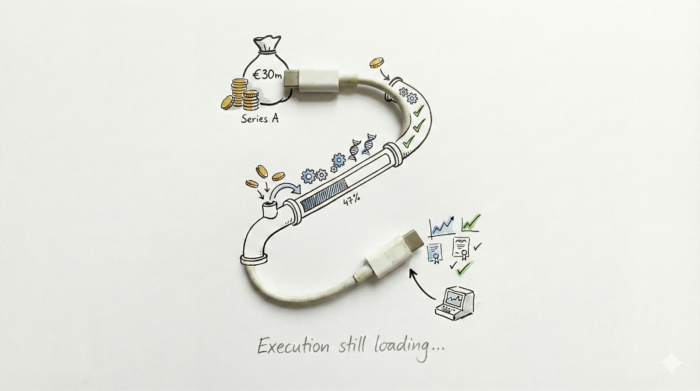
Bactolife, the Copenhagen-based biotech company, has closed a Series B of more than €30m to commercialise its binding proteins technology and fund a human study programme, ahead of a planned US launch in 2026. Separately, Aarhus-based Cordulus raised €6.8m in Series A funding to expand its artificial intelligence weather forecasting solutions into the energy sector, where forecast precision underpins risk management, portfolio optimisation and pricing.
For chief executives and human resources leaders, the practical question is straightforward: what team structures do these businesses require to convert funding into outcomes – without allowing hiring to become a bottleneck?
The common thread: proof velocity over feature velocity
Biotech and energy-focused AI may appear distinct on a pitch deck. Operationally, they share important characteristics: the product exists in the physical world – biology, weather, markets, regulation – and being “almost right” carries substantial costs. Validation and reliability are not support functions; they are core capabilities.
This explains why hiring demand concentrates in four areas that reduce execution risk:
- Data and machine learning specialists capable of operating in production environments
- Applied backend engineers handling delivery, integrations and access control
- Validation and quality assurance professionals who serve as the credibility function
- Platform reliability engineers, since downtime and undetected errors translate directly into financial or clinical risk
Blueprint one: biotech and bio-solutions
Bactolife’s stated use of proceeds is instructive: commercialisation and a human study programme, targeting a US launch in 2026. This represents a validation-intensive path.
The minimum viable team for real-world delivery – typically the first 12 to 20 hires – should include a chief executive or general manager focused on commercial urgency; a science or clinical lead who owns the definition of “proof”; a product lead who translates scientific findings into measurable claims; a data and analytics lead responsible for reproducibility and analysis integrity; a backend lead overseeing traceability, permissions and partner integrations; a senior quality assurance and validation lead who defines acceptance criteria; and a platform reliability owner, which may be fractional in the early stages but must be explicitly assigned.
The sequencing matters. In biotech, moving fast and fixing later extracts interest payments in lost credibility. Quality assurance and validation should come first, establishing that “done means valid” before scaling. Data and analytics follow, ensuring evidence is repeatable. Backend expertise makes data and workflows auditable. Reliability prevents the incidents that destroy confidence.
When screening candidates, useful questions include asking them to describe an instance when they halted a project that appeared to be progressing but lacked validity, or how they ensure analyses remain reproducible across personnel and time. A significant warning sign is any candidate who treats quality assurance as a phase occurring at the end of development.
Blueprint two: AI for energy
Cordulus has been explicit about its energy market expansion: the objective is to apply forecasting to energy trading contexts where precision determines risk, pricing and portfolio decisions. This shapes the team differently. The company is not building a demonstration of AI capability. It is building a system that customers will use to make decisions under uncertainty.
The minimum “energy-grade” team – typically the first 12 to 25 hires – should comprise a chief executive or commercial lead conversant in the buying centre and risk terminology; a product lead who understands energy workflows, service level agreements and what customers trust; a data engineering lead focused on quality, monitoring and pipelines; a machine learning lead with discipline around evaluation, drift, uncertainty and error budgeting; a backend lead managing APIs, integrations and customer delivery; a site reliability engineer responsible for availability and incident response; and quality assurance specialists who frame acceptance criteria as risk controls.
The hiring sequence that prevents what might be termed “model theatre” begins with data engineering, because production machine learning fails on data quality and monitoring first. Next comes an ML evaluation lead, because accuracy without uncertainty quantification is marketing. Backend delivery follows, because customers purchase integration, not notebooks. Site reliability engineering ensures availability becomes part of the trust proposition. Quality assurance completes the sequence, because “when we are wrong” must be measurable and clearly communicated.
Screening questions that reveal operational maturity quickly include asking how candidates detect drift in production and what they do upon discovering it, how they communicate uncertainty without eroding customer trust, and asking them to describe the last incident they managed and what changed as a result. A warning sign is any candidate who discusses model architecture without addressing monitoring, failure modes and operational controls.
The message for boards in 2026
A clear way to frame this internally: the company is hiring for execution risk reduction – validation, data integrity, delivery systems and reliability – because that is what converts deeptech funding into outcomes.
These rounds provide evidence that deeptech remains fundable in Denmark, but only when the company can demonstrate and deliver proof. Hiring like a generic software-as-a-service operation will consume months discovering why deeptech differs. Hiring according to these blueprints purchases the one asset investors still reward: credible execution.
Q&A
What roles should deeptech startups hire first?
Deeptech startups should prioritise hiring for execution risk reduction. The four key roles are: data and machine learning specialists capable of operating in production environments; applied backend engineers handling delivery, integrations and access control; validation and quality assurance professionals; and platform reliability engineers. These roles reduce execution risk because deeptech products exist in the physical world where being “almost right” carries substantial costs.
What is the difference between hiring for biotech versus AI startups?
Biotech startups should hire validation and quality assurance leads first, followed by data and analytics, then backend engineering, and finally reliability. AI startups serving sectors like energy should begin with data engineering, then ML evaluation specialists, backend delivery, site reliability engineering, and quality assurance last. Both require proof-focused teams, but biotech prioritises validation from the outset while AI companies must first ensure data quality and monitoring infrastructure.
Why is proof velocity more important than feature velocity in deeptech?
Proof velocity matters more than feature velocity in deeptech because these companies operate in regulated, physical-world domains – biology, weather, markets – where validation and reliability are core capabilities rather than support functions. Investors reward credible execution, and being “almost right” is expensive. Companies that hire for evidence-led execution convert funding into outcomes; those that hire like generic SaaS teams burn months discovering why deeptech is different.
What interview questions should you ask deeptech candidates?
For biotech roles, ask candidates to describe a time they stopped a project that looked like progress but was not valid, and how they make analyses reproducible across people and time. For AI and energy roles, ask how they detect drift in production and respond to it, how they communicate uncertainty without losing customer trust, and ask them to describe their last incident and what changed afterwards. Candidates who treat QA as an end-phase or discuss only model architecture without mentioning monitoring and failure modes are red flags.
What team structure does a biotech startup need?
A biotech startup’s minimum viable team for the first 12 to 20 hires should include: a chief executive focused on commercial urgency; a science or clinical lead who defines proof; a product lead translating science into measurable claims; a data and analytics lead for reproducibility; a backend lead for traceability and integrations; a senior quality assurance and validation lead; and a platform reliability owner. The sequencing matters because moving fast and fixing later damages credibility in biotech.
What team structure does an AI-for-energy startup need?
An AI-for-energy startup’s minimum team for the first 12 to 25 hires should comprise: a chief executive versed in risk terminology; a product lead understanding energy workflows and service level agreements; a data engineering lead for quality and monitoring; a machine learning lead with evaluation discipline around drift and uncertainty; a backend lead for APIs and customer delivery; a site reliability engineer; and quality assurance specialists who frame acceptance criteria as risk controls. This structure prevents “model theatre” where impressive demonstrations fail in production.