
 Publish date: 13 January, 2026
On a grey Tuesday in Copenhagen, a familiar ritual plays out in tech companies from Østerbro to Islands Brygge: a sprint review that turns into a hiring meeting.
Not because the product is unclear.
Because the capacity is.
The roadmap is full, the investors want momentum, and somewhere in the org chart there’s a missing senior engineer role that has quietly become the bottleneck for everything else. In Denmark, that is not an exception. It’s the operating climate.
So let’s talk about the Denmark–Bulgaria comparison the only way it’s worth talking about: with a clean benchmark, and a practical strategy for what to do with the difference.
A benchmark that’s hard to argue with
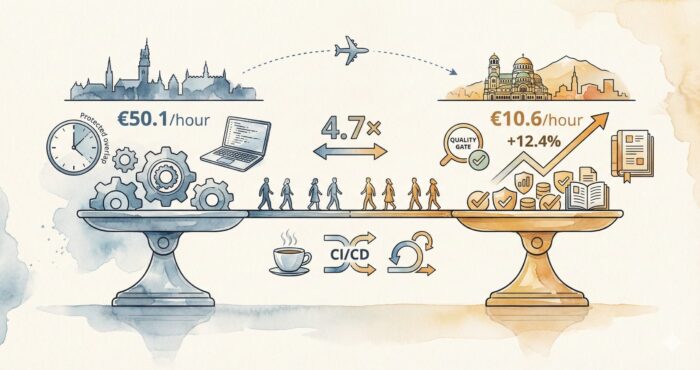
Eurostat’s latest annual estimates for 2024 put average hourly labour costs at:
- Denmark: €50.1 per hour
- Bulgaria: €10.6 per hour
That’s a ratio of ~4.7× (50.1 / 10.6). The shorthand “~5×” is broadly correct – but if you’re going to use the number, use it precisely.
A note, because precision matters: Eurostat’s metric is economy-wide and measures the total cost to the employer(wages and salaries plus non-wage costs like employers’ social contributions; and related items depending on methodology). It’s not a day rate. It’s not an agency invoice. But as a structural comparison, it’s one of the cleanest starting points we have.
The important nuance: the gap is real – and it’s moving
The temptation is to treat this gap as a permanent discount. It isn’t.
Eurostat reported that Bulgaria had the highest increase in hourly wage costs in the EU in Q3 2025 (+12.4% year-on-year).
That doesn’t erase the gap. It simply tells you how to behave: treat the delta as headroom to invest, not as a margin to extract.
What the delta is really for
Here’s the mistake many Danish companies make when they first go nearshore: they treat Bulgaria as a cheaper Denmark.
They hire faster. They hire more. And then they discover the hidden cost: onboarding friction, governance overhead, and reliability problems that show up in production at 02:00 – which, inconveniently, is when founders become very interested in “culture”.
The smarter approach is to spend the delta on three things Denmark is expensive for a reason:
- Seniority
- Onboarding
- Reliability
If you get those right, nearshore stops being “outsourcing” and becomes “capacity expansion with Danish standards”.
1) Spend on seniority, not headcount
The labour-cost gap is large enough that you can do something most companies hesitate to do: overpay for quality in the nearshore market.
Not irrationally. Strategically.
Use the delta to:
- hire fewer people, but more senior
- pay above local market to reduce churn
- recruit engineers who can take ownership, not just tickets
The payoff isn’t just better code. It’s less management load, fewer clarifications, and fewer “why does this take so long” moments.
In practice, you’re buying judgement – and judgement is what keeps roadmaps on track.
2) Spend on onboarding like it’s a product
Danish companies like process when it serves trust and transparency. Distributed teams need the same thing: a shared understanding of “how we work here”.
Use the delta to build onboarding infrastructure:
- a week-by-week onboarding track
- definition-of-done checklists and quality gates
- architecture primers and repo walkthroughs
- a clear “first PR” path that is safe, measurable, and fast
This is the part nobody wants to do because it feels like overhead.
It’s also the part that prevents “we hired fast, and then slowed down”.
3) Spend on reliability so delivery becomes predictable
The most expensive software is not the software you build. It’s the software you build twice.
Use the delta to fund reliability basics that too often get postponed:
- automated testing that blocks regressions
- CI/CD discipline
- logging, metrics, tracing
- incident routines: ownership, postmortems, follow-up actions
If you’re a founder, you should read this as: “Spend now so you don’t pay later, in customer trust.”
4) Spend on shared context – yes, including travel
Copenhagen and Sofia are close enough that “we never meet” is a choice, not a constraint.
Use the delta to create:
- overlap hours that are protected (not a “nice to have”)
- quarterly in-person workshops (planning, architecture, retrospectives)
- rituals that export Danish working culture: clarity, accountability, directness
This is how you avoid the classic split-brain org: strategy in Denmark, execution elsewhere. It should feel like one team.
A simple way to allocate the delta
If you want a practical rule-of-thumb, start here:
- 40% → seniority premium (pay for top talent, not average)
- 20% → onboarding & documentation
- 20% → reliability/platform work
- 10% → overlap + travel
- 10% → retention (learning, progression, stability)
The point is not the exact percentages. The point is the principle:
Optimise for delivery reliability per krone, not savings per hour.
The line you should use internally
If you want this to survive CFO scrutiny, don’t frame it as “cheap talent”.
Frame it as an operating model upgrade:
“We’re reallocating cost headroom into senior capacity and reliability, so we can ship faster without burning trust, budget, or culture.”
Because that’s what the Denmark–Bulgaria delta is actually good for.
And one final reality check: Eurostat also notes that comparisons in euro can be affected by exchange-rate movements for non-euro countries — so treat the benchmark as a compass, not a contract.
The conclusion remains stable: the gap is large enough to matter. The winners will be the companies that spend it on the boring things that make software delivery predictable.
FAQ -> Denmark vs Bulgaria labour-cost benchmark
What’s the cleanest benchmark for Denmark vs Bulgaria labour costs?
Eurostat’s 2024 estimate of average hourly labour costs: Denmark €50.1/hour vs Bulgaria €10.6/hour (~4.7×).
Is this the same as a developer hourly rate or agency day rate?
No. It’s an economy-wide measure of the total employer cost (wages + non-wage costs such as employers’ social contributions, etc.).
So is “~5× cheaper” true or marketing?
It’s broadly true directionally, but the precise 2024 ratio is ~4.7×, not exactly 5×.
Is the gap stable over time?
Not fully. Bulgaria’s labour costs are rising quickly; Eurostat reported Bulgaria had the EU’s highest increase in hourly wage costs in Q3 2025 (+12.4% YoY).
What’s the biggest mistake companies make with the cost delta?
They chase “savings” or headcount, then pay later in onboarding friction, governance overhead, and reliability issues.
What should Danish teams do with the delta instead?
Reinvest it into three drivers of delivery outcomes: seniority, onboarding, and reliability.
Why prioritise seniority over more hires?
Seniority buys judgement: fewer clarification cycles, less rework, and less CTO time spent unblocking—so shipping speeds up.
What does “onboarding like a product” mean?
A structured track with clear milestones, definition-of-done checklists, lightweight architecture primers, and a safe path to a first PR.
What reliability investments deliver the highest leverage?
CI/CD discipline, automated tests that block regressions, observability (logs/metrics/traces), and clear incident routines.
Do we need overlap hours and travel, or can this be fully async?
For most teams, overlap and periodic in-person workshops pay back fast by creating shared context and preventing “split-brain” delivery.
What’s a simple way to allocate the delta budget?
A practical rule of thumb: 40% seniority premium, 20% onboarding, 20% reliability/platform, 10% overlap/travel, 10%retention.